Telling Your Story: The Garden Entry Sequence
Designing a garden is rather like telling a story; there needs to be an introduction that draws you in, an understanding of the key characters as they weave through each chapter and a satisfying conclusion.
The garden introduction begins when you get the first glimpse of the home and how it is settled into the landscape. As you walk along the path towards the front door, there is an opportunity to make a statement – tell visitors a little about yourself. That might be by your color choice (pastels or bold?), art selection (contemporary or whimsical?) or plant combinations. Just as every person is unique, every garden introduction can also be unique to reflect the homeowners who live there. Designers refer to this garden introduction as the 'entry sequence'.
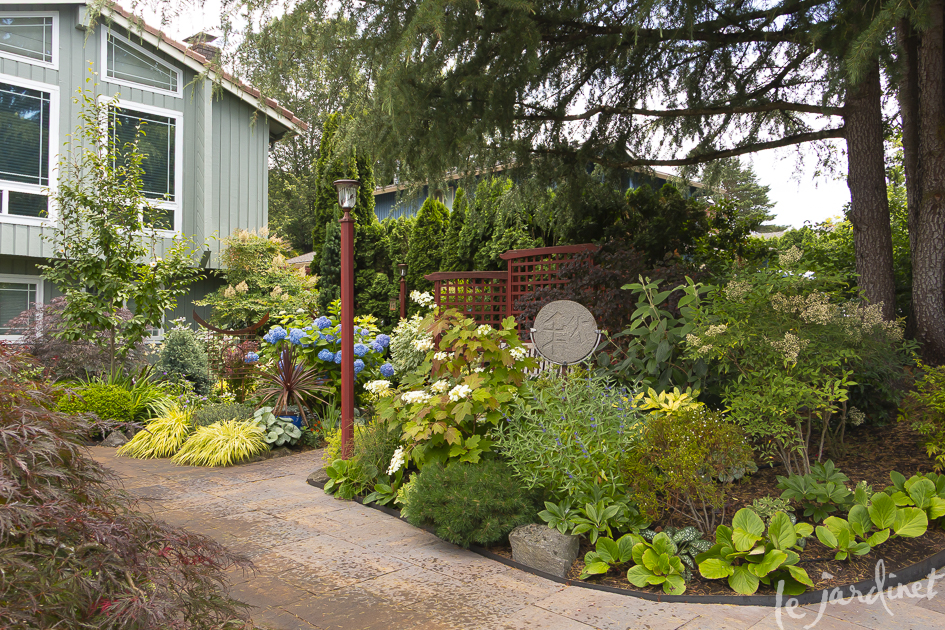
This first photo of a private garden in Portland tells a wonderful story. Designed by 4 Season Gardens LLC it offers a glimpse into the homeowners color and plant palette preferences as well as their interest in Asian culture or design. I'm intrigued already, aren't you?
The entry sequence is not the same as 'curb appeal' which suggests simply making things look presentable for the benefit of passers by. Rather an entry sequence is an opportunity to give a very personal welcome to your visitors and reveal a little about yourself.
Ideas and Inspiration
Whenever and wherever you travel there are always take-home ideas, but it takes practice to look past the 'Can I grow that?' question and learn to assess design elements. Look at the examples below and see what the entry sequence tells us about the homeowners – focus on the design rather than plant specifics.
1. I've got time for you

A beautiful example of a well thought out front entry: Buffalo, NY
Everything about this small front garden invites you to slow down and enjoy the moment. The entry patio doesn't just hurry you to the front door but rather encourages you to sit on the wall, smell the flowers, listen to the tiny bubbling fountain tucked away into the corner.
The steps to the porch are generously wide, allowing for two to walk comfortably side by side rather than single file. Color-filled window boxes and urns draw you in.
Once on the porch there are comfortable chairs just waiting for you.
These homeowners are clearly conveying a welcome. I can almost hear the kettle boiling in anticipation of visitors.
2. I'm not your typical gardener!
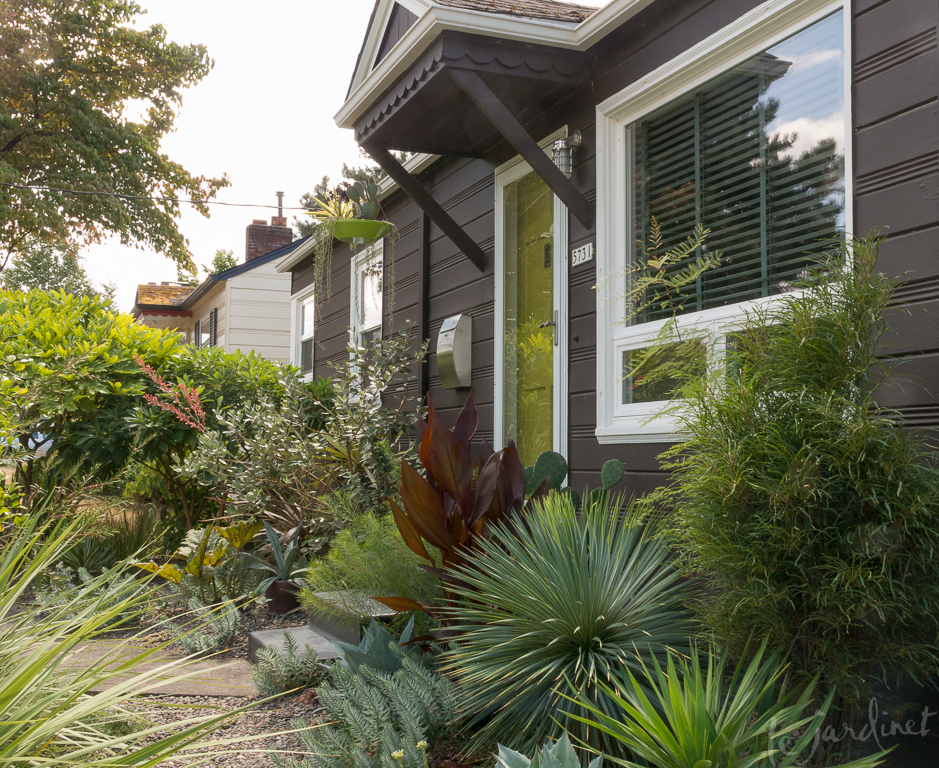
Stunning waterwise design by Loree Bohl, Portland, OR
As author of Fearless Gardening and longtime blogger, Loree Bohl knows how to write a good story – and her front garden is a clear introduction to both her garden story and her garden preferences. Forget the daisies and delphiniums, Loree is the queen of all things spiky and her fabulous garden is a riot of exciting textures and forms. Creating a garden with so many long, spiky leaves is not without its challenges. Aside from avoiding injury, Loree has done a remarkable job of achieving a pleasing level of contrast from between the needle-like but feathery Arkansas blue star with the more rigid blue-green yucca foliage, adding the bolder canna and prickly pear leaves as counterpoint.
Everything about this entry sequence tells me this isn't going to be a quick visit – we have lots to talk about!
3. Fun and Friendly
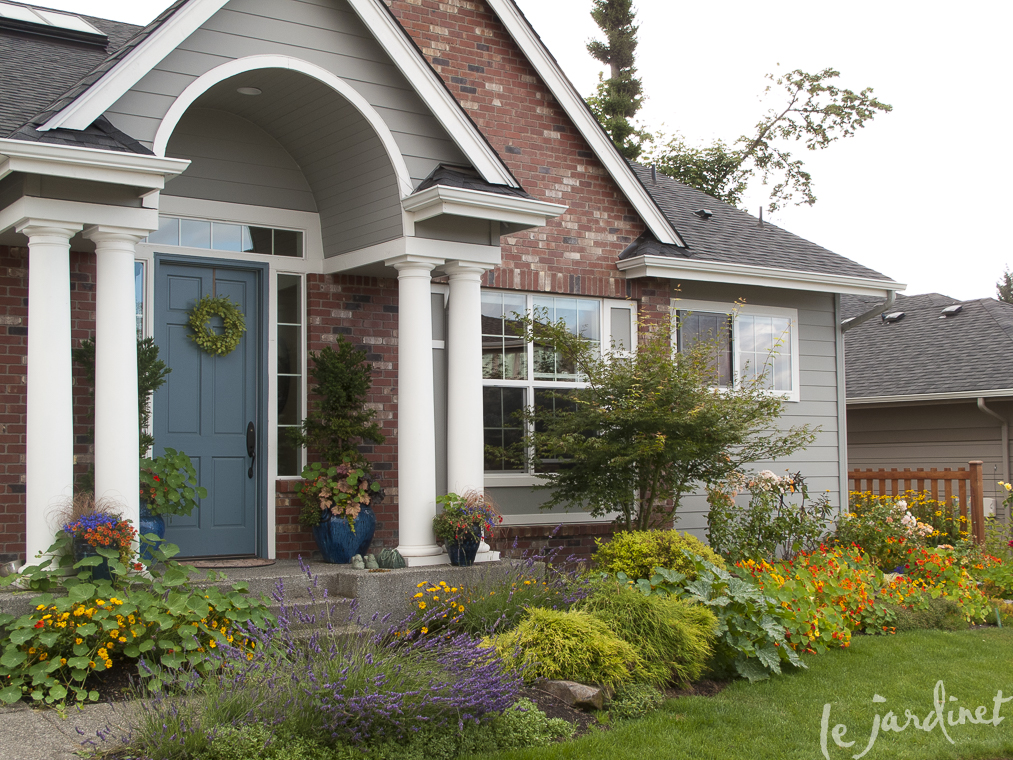
There's nothing shy or apologetic about this entry – it's as full of life and color as the lovely homeowner
When plants scramble across the driveway to meet you like an over-excited puppy you can't help but smile. And when the garden is full of HAPPY colors you know you're going to enjoy meeting the homeowner Debbie.
It's clear that yellow and blue are Debbie's favorite colors in the garden with a pop of orange for contrast. Look more closely and you'll see squash jostling for space with the riot of nasturtiums alongside more typical conifers and lavender
Giving the Wrong Impression.
It's easy to stop 'seeing' our own garden. It becomes so familiar that we ignore it – or pull straight into our driveway without giving the entry sequence a second glance.
1. Lack of vision or neglect?
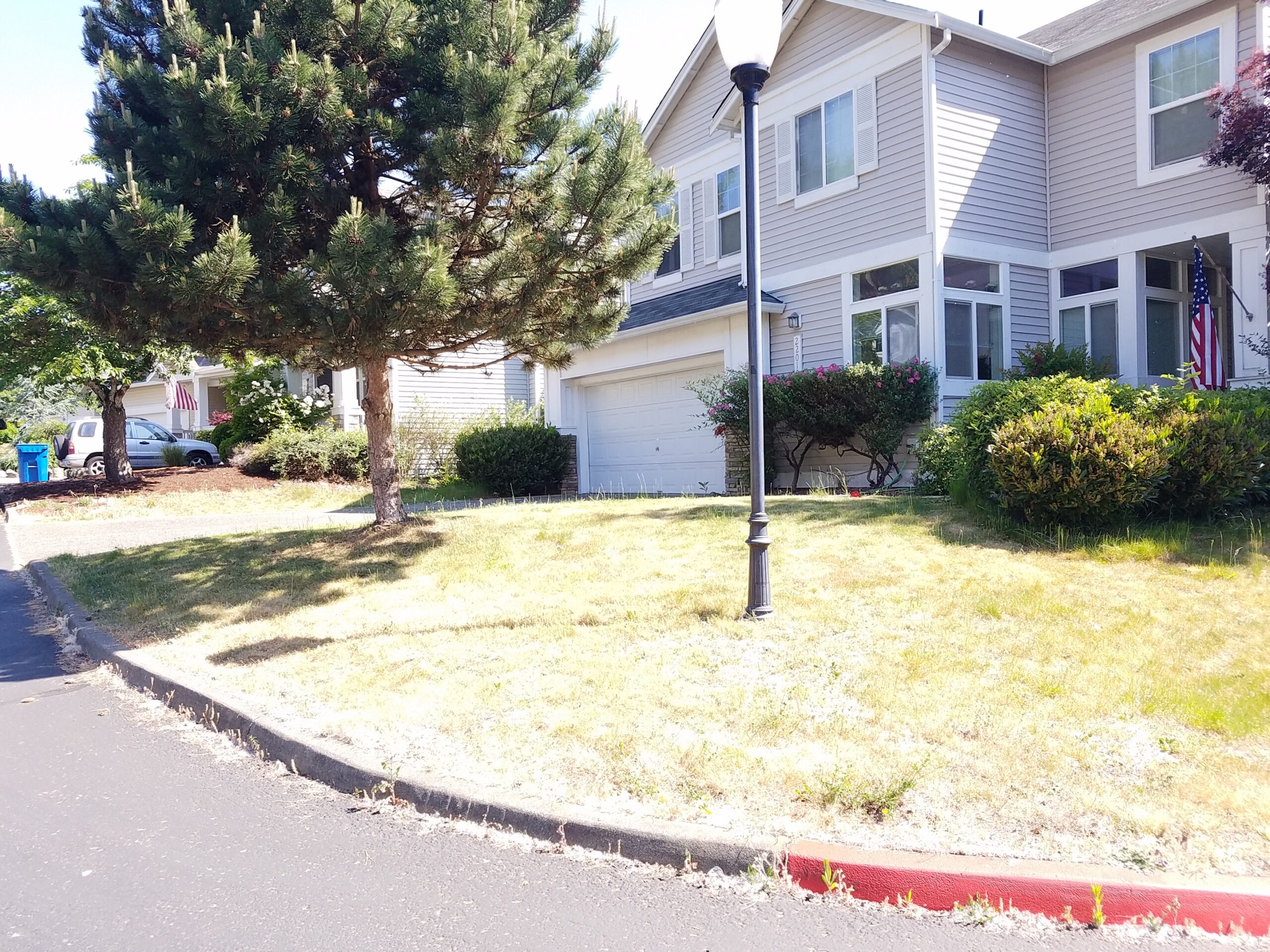
Weeds, parched grass and 'builder's basics' foundation plantings
In fairness to the homeowner above, this was the 'before' photo, taken by the landscape designer they called to correct the problem – but it illustrates an important point. A neglected front garden suggests homeowners who simply don't care. This is a lovely home in a nice neighborhood, but for whatever reason the homeowners didn't 'see' or understand the importance of the front garden and the message it conveys.
2. Keep Out!

Dense hedging and towering evergreens obscure the entry
These homeowners are a wonderful, friendly, welcoming couple – but you'd never know that from their entry garden! Thankfully they recognized the disparity so we were able to transform it into something that is a much better reflection of their personality. You can read about the 'before and after' story here.
3. "It does the job…"
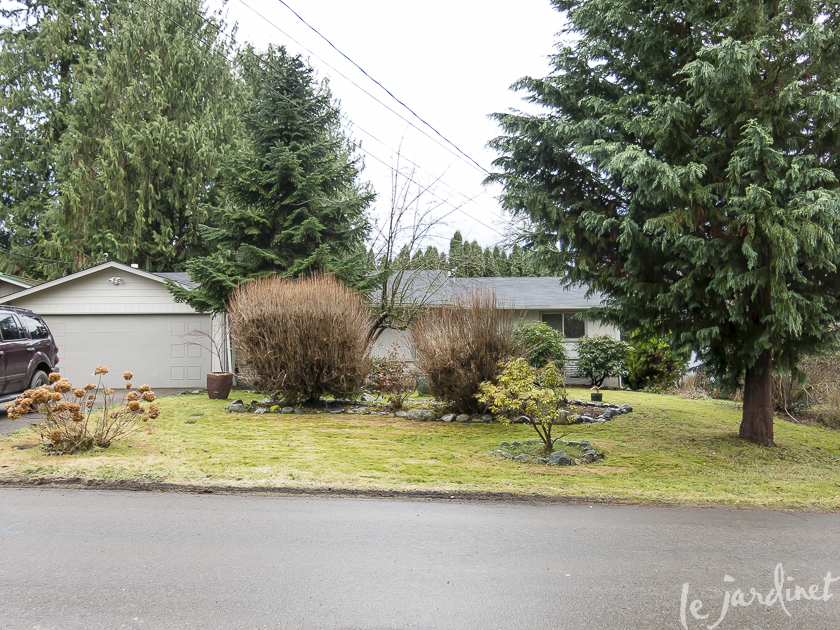
Before renovation the neglected front garden was filled with random, overgrown shrubs. Large rocks around planting beds made lawn maintenance difficult.
Rented out for years, this home and garden had survived with the bare minimum of maintenance and zero strategic design. Yes, there were trees, shrubs and lawn and the beds even defined by a necklace of toe-stubbing rocks but the overall impression makes it clear that no-one here really cares.
I'm delighted to say that we totally transformed this into a colorful, functional, welcoming space – you can read all about it here.
Want to Learn More?

Understanding the entry sequence is just one of many design tenets we will study together in my half day Designer's Eye Workshop. If you live within easy reach of Bellevue, Washington I'd love you to join me.
I'll be using the Bellevue Botanical Garden as our 'classroom' for the afternoon. This wonderful facility is so much more than collections of plants – it offers a bounty of design lessons if you know how to look. If you're a visual learner (like many gardeners are), you'll enjoy this opportunity to learn how designers "see" a space which in turn will help you better understand why some areas of your own garden are still "not quite right". It's also a great way to learn to analyze gardens – so important when we visit gardens outside our home area and see plants that we can't grow at home. By understanding the design lessons you'll see there is always something we can learn, no matter where we are.
This workshop is limited to 25 guests and is already well over half full with guests joining from as Idaho as well as in-state. Don't delay – get the full details and sign up today.
Subscribe to Receive Blog Posts
Gardening inspiration delivered right to your inbox from Le Jardinet
Note; this post contains some affiliate links which will earn me a few pennies towards my next plant purchase.
This is really a revelation for me, thank you. I’ve always thought of a garden as a narrative, an environment that tells a story designed to elicit emotion and inspire, but I’ve never really thought about what it tells other people about my home, and me, at very first sight, what kind of invitation the entry is. Has me rethinking my garden plan!
So glad you enjoyed the post Gita.
Gosh that was a surprise! I'm glad I wasn't one of the "Giving the Wrong Impression" group. Thank you for the kind words. I am embarrassed to admit I don't remember you visiting my garden. Judging by the photo it was awhile ago.
It was many years ago now – I think it was during an open garden event
[…] can apply these same storytelling characteristics to our gardens. In my last blog post I shared ideas to help you create your introduction; an entry sequence that reflected your […]